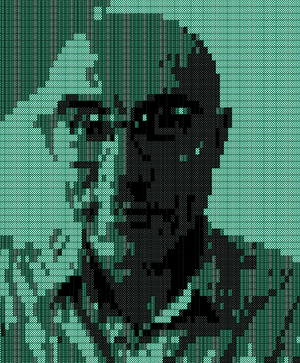
Buffalo Bones: Larry McMurtry’s American West
This piece originally appeared in The London Review of Books in June 2026. A fair amount of it had to be cut, so The LRB agreed to let me publish the original version here.
In the summer of 2024, around the time the enfeebled US President was being pressured to abandon his re-election campaign against Donald Trump; while Project 2025, a right-wing policy document advocating for the rollback of civil rights and the welfare state, and demanding a return to antiquated gender roles and an embrace of Christian fundamentalism, circulated among seemingly indifferent reporters and pundits; as podcasters with surgically altered chins, bankrolled by Russian spies and dietary supplement manufacturers, declared a crisis in masculinity for which women and immigrants were apparently to blame; my writer friends—my female writer friends in particular—were finding solace in a surprising source: Larry McMurtry’s award-winning 1985 western novel Lonesome Dove.
Surprising to me, anyway—I was aware of McMurtry, but had the impression that he had been a prolific, perhaps too prolific, author of sentimental bestsellers, almost all of them sequels or prequels to previous sentimental bestsellers. I knew that a few good movies had been adapted from his work, but had mentally classified him alongside Sidney Sheldon, Colleen McCullough, and John Jakes, writers of great popular appeal in my youth, whose moment had passed and whose work was unlikely to be revisited.
I ought to have known better. I came of age as a writer in the nineteen-nineties, in Montana, where I’d moved to attend graduate school, and cut my literary teeth on the literature of the contemporary American west—writers like James Welch, Leslie Marmon Silko, Donald Barthleme, Pam Houston, and Rick Bass, some of whom counted McMurtry as a friend. But I think I must have regarded the used-bookstore ubiquity of his paperbacks disqualifying, and I had developed a taste for western literature that undermined the myth of the cowboy: his ambition, rugged individualism, and bravery against the savage Native. My favorite western writers embraced literary style over melodrama, forgrounded Native history and culture before white settlers’, and subtly explored the lives of girls and women. Surely McMurtry wasn’t for me.
As it happens, this misapprehension plagued McMurtry his whole career. In an often-absorbing, sometimes-vexing new biography by Tracy Daugherty, McMurtry is seen to bemoan readers’ acceptance of his characters at face value, and their misidentification of cowboy selfishness as heroism. “I don’t think these myths do justice to the richness and fullness of human possibility,” he said; traditional gender roles don’t make “for the best sort of domestic life.” McMurtry’s own domestic life, in both his childhood and adulthood, suggests a kind, sensitive, ambivalent man in perpetual conflict with responsibility and desire, tradition and contemporary morality. The child of Texas farmers and ranchers, McMurtry grew up with both the anecdotal memory of white settlers’ “old west” and the living experience of its extinction. Bookish, ambitious, he hungered for the urbane and intellectual, but would grow weary of the moneyed and academic worlds that claimed him, and longed to return home—something he finally did late in life, buying up real estate in diminutive Archer City and filling it with used books, to the mingled pride and dismay of the hardscrabble neighbors of his youth. He befriended countercultural icons, most notably Ken Kesey, whose ex-wife he would someday marry—but never really fit in with them. He liked staying home and writing too much. (Daugherty gives us a good anecdote about a nude woman, tripping on LSD, running out of the Merry Pranksters’ bus and into McMurtry’s yard, where she embraces his toddler, mistaking him for her own child. “Ma’am, would you please let go?” McMurtry pleads. “The boy is crying, ma’am.”) Devoted to his son, who would become the celebrated singer-songwriter James McMurtry, he nevertheless endured a rocky early marriage, with multiple affairs on both sides, before settling into a lifetime of not settling into much at all. (“A fuck boy,” one of my aforementioned writer friends called him, not without some admiration.) I don’t think I’ve ever heard of a person on better terms with his exes, though; to read of McMurtry’s affairs is to behold a man who thinks of sex primarily as a means of forging lifelong friendships.
The love affairs also suggest that, among the characters that populate Lonesome Dove, its sequel, and its two prequels, McMurtry may have identified most powerfully with Augustus McCrae, the books’ philosophically good-humored and perpetually horny co-protagonist. Then again, in his unwillingness to telegraph his intentions, his solitary single-mindedness, McMurtry also resembles McCrae’s opposite, Woodrow F. Call; “McMurtry saw this grim tenacity in his father and in his father's brothers,” Daughtery tells us, “and he felt it growing in him.” It’s certainly not an original idea that Gus and Call might reflect conflicting—yet indispensably complimentary—sides of their author, but it does make reading this quartet of novels more fun, especially read alongside the biography.
My friends certainly had fun with Dove. “It’s women who love it this time around,” one told me. “It has taught me about the inner lives of men. I avoided reading it for two decades for various reasons, but when I did, I understood...the men who have been telling me to read this were trying to tell me something about being a man.” It’s true that the perpetually online American men whose inner lives we’re usually exposed to in 2026 are angry, vindictive, ignorant, and cruel—misogynists, grifters, and gamblers enriching themselves by disseminating misinformation and fomenting rage. Another way must exist for men to be—maybe McMurtry holds the key.
*
In these new reprints, the Dove novels comprise about 2500 pages, and lined up beside one another are about as wide as they are tall. Picador seems to want you to read them in order of narrative chronology, not publication order, and after spending a month in the company of this hefty cube of prose, I have to agree. Though the two prequels are not its equals, they can serve as emotional and historical ballast for their longer, funnier, and more profound original. Taking the four together offers a conceptual reset to the reader returning to books they might not remember well, or a fresh start for the uninitiated. The way the books were originally published couldn’t have served them well; Streets, a direct sequel to Dove published a decade later, must have cast a shadow over the two prequels that arrived fast on its heels, deep within McMurtry’s career phase of rehashing old material. But Dead Man’s Walk and Comanche Moon are entertaining and at times excellent, and deserve reassessment. You can feel, in Streets of Laredo, McMurtry having to talk himself into returning to the well, and finally discovering, with those prequels, that old spark.
Gus and Call are introduced in Dead Man’s Walk as adventure-seeking teenagers who join the Texas Rangers, a then-nascent, loosely-organized armed enforcement agency dedicated to protecting white settlers in the republic of Texas from Mexican and Native attacks. A glance at a map from this era—context tells us it’s the 1840s—reveals a United States occupying less than half of its present-day territory, with much of the west consisting of Texas (on the brink of statehood), Mexico, and a broad range of Native tribes. That all this territory would be seized, and its occupants conquered, within only half a century, provides a dark subtext to the novel’s general tone of winking picaresque, as our bumbling protagonists stagger from one failure to another—soldiers of misfortune. After an initial botched outing in which the reader is introduced to the prequels’ primary foe, the Comanche chief Buffalo Hump, the two boys fall under the command of “Colonel” Caleb Cobb, a mercenary and former pirate, and are led on a mission, akin to the historical Texan Santa Fe Expedition, to annex part of Mexico. This second part of the book also introduces us to two important figures in the books to come: Maggie Tilton, a sex worker (in the parlance of these novels, “whore”) who will give birth to Call’s son Newt, and Clara Forsythe, a wisecracking general-store clerk who will serve as Gus’s perpetually unrequited love for the next two novels, and emerge as a heroine of Lonesome Dove.
Readers who started with Dove will be startled by the Gus of Dead Man’s Walk. The wise, good-humored philosopher of the later book is nowhere to be found; this Gus cares only about getting laid and serves mainly as comic relief. New to the series, I found him insufferable and groaned when I learned, from the back flap of Dove, that I’d be with him for many pages to come. Conversely, Call seemed wildly appealing for a young man, a model of preternatural self-control and integrity, perpetually annoyed by Gus. Over the course of these first three books, however, McMurtry slowly develops the friendship between the two men, shifting the balance between them in the reader’s estimation. Gus is allowed to mature; he learns from his mistakes, and through his sexual exploits comes to appreciate the unfairness of a woman’s role in the lawless world the characters inhabit. Call, on the other hand, proves rigid and self-denying; his only visit to Maggie will result in the child he will never acknowledge, and the longer he goes without marrying her—we learn, over the course of Dead Man’s Walk, how unsuited she is for the hand she’s been dealt—the less we like him.
The most striking thing about this book is the clarity of its take on American conquest and expansion. In Dead Man’s Walk, every adventure is undertaken for its own sake, by stunted men who consider cruelty and hardship ends unto themselves. There’s no reason for any of this to happen, and McMurtry expertly plays on the reader’s sense of dread every time the Rangers embark upon another doomed errand. Authority is situational here, rather than bound by laws or regulations; Caleb Cobb, a self-aggrandizing brute with no official military rank, simply calls himself a colonel, and so is one. Conversely, authority can disappear in an instant. It is all, much like the current American regime of lawbreaking opportunists, supported by collective belief, and once trust is lost, everything can simply fall apart. No one really knows what they’re doing; they’re pretending, even to themselves. It’s disheartening to recognize this clear line from colonial piracy and lawlessness to MAGA, but it does make this novel feel fresh and relevant, and gives this discouraged twenty-first-century American some hope that every fool really is his own worst enemy.
Eventually, the Rangers and their hangers-on are whittled down to a skeleton crew of ten, who, captured by the Mexican army, are forced to draw black and white beans from a jar to determine which half of them will live and which will be executed. (The scene is clearly inspired by the historical “Black Bean Episode” of 1843, in which one in ten members of the failed Texan Mier Expedition were chosen for execution by a Mexican colonel in a bean-choosing lottery.) Gus and Call, of course, survive.
Dead Man’s Walk suffers, at times, from authorial overreach—its bawdy humor wears out its welcome after a while, its third-person point of view ricochets wildly from character to character, it trafficks in racial stereotypes and intense depictions of torture, and scenes often unfold with redundant detail or pointlessly protracted exchanges of dialogue—but, for all that, I found it wildly compelling. You can feel McMurtry responding, in his granting to Buffalo Hump a point of view, a political morality, and a complex family, to complaints that the Natives in Dove were portrayed as generically brutal warriors. We also get the origin story of Dove’s Blue Duck, introduced here as Buffalo Hump’s wayward child, and the extraordinarily talented horse thief Kicking Wolf. McMurtry’s painterly portrayal of the western landscape gives us all its wild emptiness and extreme shifts in weather; one memorable scene has the Rangers encountering "thousands of buffalo, browner than the brown water" and crossing the herd in a furry analogue of the novel’s perilous river crossings.
Comanche Moon is everything Dead Man’s Walk is, but more so: its drama is intenser, its descriptive prowess magnified, its characters more detailed. But it’s also more redundant, more silly, more brutal, and far too long. This time, the Rangers are sent by the governor of Texas to capture Kicking Wolf, and are put under the command of Inish Scull, a pampered eccentric in possession of a legendarily large horse, Hector, and an unfaithful wife. For the first hundred pages or so, Scull’s pomposity is wildly overplayed, and it seems like he’ll be a figure of fun for the duration of the book, but when Kicking Wolf steals Hector, Scull comes into his own, setting out after his quarry on foot and leaving Gus and Call in charge of the now-diverted expedition. Eventually Scull tracks Kicking Wolf to Ahumado, the cruel Mexican bandit who has captured him; Scull frees his nemesis and ends up imprisoned and tortured by Ahumado for the next three hundred pages. He escapes with his life intact but his eyelids cut off. I hate these passages, but I love Scull, who serves as the mouthpiece for many of the series’s themes, particularly the self-justifying nature of war. “It's the quality of the opponent that makes soldiering a thing worth doing,” he says early in the novel. “It ain't the cause you fight for.” By the story’s end, afflicted by parched eyes that can never look away from anything, Scull refuses military orders in favor of writing his memoir:
"See this page of paper? It's blank," Scull said. "That, sir, is the most frightening battlefield in the world: the blank page. I mean to fill this paper with decent sentences, sir—this page and hundreds like it. Let me tell you, Colonel, it's harder than fighting Lee. Why, it's harder than fighting Napoleon. It requires unremitting attention, which is why I can't oblige the President, or the generals who sent you here."
There’s no indication in Daugherty’s biography that McMurtry found writing hard, particularly; one of the book’s weaknesses, in fact, is that it doesn’t say much about writing at all. I’d hoped for more detail, perhaps from McMurtry’s notes or correspondence, about his intentions with these prequels, or about their research and composition. But there’s nothing; the two books barely get a mention. Conversely, there are many pages about the movies derived from McMurtry’s work, and a bewildering amount of information about Peter Bogdanovich’s affair with Cybill Shepard. I don’t object in principle to knowing all this—the same goes for the biography’s long diversion about Kesey, the Merry Pranksters, and sixties counterculture in general—but it has been generously documented elsewhere, in other books. What I longed for was a sense of McMurtry’s process, what he was actually doing on the most frightening battlefield in the world. Daugherty’s book doesn’t deliver it.
Comanche Moon delivers what it needs to, I suppose; Gus and Call continue to evolve into their canonical Dove characters, Native influence over the west begins to wane, and American power extends shaggily over the empty landscape. “The buffalo won't return,” Buffalo Hump tells Kicking Wolf, “because they are dead. The whites have killed them. When you go north you will only find their bones.” Gus is frustrated by “the diminished status of the rangers. For years the rangers had provided what protection the frontier families had; it was hard, now, to find themselves treated as no better than local constables.” Blue Duck kills his father, Maggie dies and leaves Call’s son an orphan, Clara marries a dullard, and the stage is set for at last for Lonesome Dove.
It goes without saying that Dove is a bittersweet elegy—for the white western way of life, for the era of American expansion, for the cowboy. It’s also, perhaps too subtly, a critique of those things, and this implied criticism is what saves the book from the sentimentality I long assumed it embraced, and which kept me away from it for so long. The overarching plot that drives it is about leaving Texas for Montana, the last frontier; it doesn’t escape the characters’ notice that this retreat from encroaching civilization has a familiar ring. “We’ll be the Indians, if we last another twenty years,” Gus tells Call during a dispiriting visit to San Antonio, where the Rangers are greeted not as heroes but as scofflaws. “The way this place is settling up it'll be nothing but churches and dry-goods stores before you know it. Next thing you know they'll have to round up us old rowdies and stick us on a reservation to keep us from scaring the ladies.” Call isn’t having any of it—it’s a flaw in his character that he’s so busy letting the wind carry him along that can’t see which way it’s blowing.
This elegiac quality is intensified if you read the prequels first; their other primary effect is to make you preemptively angry at Woodrow Call. We’ve jumped ahead a decade or so; Newt is a teenager, having been raised by a village—specifically, the village of Lonesome Dove, the sleepy border town where middle-aged Gus and Call have founded the Hat Creek Cattle Company, a small outfit comprising the survivors of Comanche Moon. Newt still hasn’t learned that Call is his father. Into this uneasy idyll rides Jake Spoon, another ex-Ranger, now on the run from a sheriff whose brother he accidentally shot and killed in Arkansas. Spoon has heard tales of fertile land in Montana, and wanderlust infects Call; he wants to round up a herd and drive them north, to found the first cattle ranch north of the Yellowstone. Gus, reluctant at first, realizes they could stop on the way to visit Clara, who has settled with her husband in Nebraska. Who knows—maybe he’s dead! While the Hat Creek outfit heads to Mexico to rustle up a couple thousand head, Spoon gets cozy with Lorena, a sex worker who lives above the saloon. Abused, tired, and looking for escape, she convinces him to deliver her to San Francisco, after heading north with the rest of the team.
The rustling operation goes off without a hitch—an ominous sign for anyone who has read the prequels—and the Montana journey officially begins a couple hundred pages in. Meanwhile, July Johnson, the Arkansas sheriff pursuing Spoon, saddles up for his manhunt, and the moment he leaves, his unhappy wife Elmira heads to the river and jumps on a whiskey boat in search of her ex. The novel alternates among these quests, encountering the usual complement of human violence and the perils of the natural world. Eventually Jake wearies of Lorena and heads to Austin to gamble; she is kidnapped by Blue Duck and endures days of sexual assault and torture before being rescued by Gus and returned to the fold.
Native writers and scholars rightly criticized McMurtry’s portrayal here of the Comanches in general and Blue Duck in particular; coming from the comparitively nuanced characters of the prequels, themselves hardly representative of the full spectrum of Native life, the present-day reader will be startled by how little humanity these characters are granted. Blue Duck is more force of nature than man, a bloodthirsty psychopath, and his sections are among the least engaging in the book.
But this plot turn also gives us Lonesome Dove’s most moving and beautiful storyline, Gus’s efforts to protect Lorena and give her the time and space to heal. The two separate themselves from the rest of the outfit—Lorena can’t bear to be around the other men, some of whom were once her customers—and develop a bond. She comes to love him, but with a desperate intensity inextricable from her unresolved trauma and fear for her life; Gus’s awareness of this holds him back from romantic attachment, even as he comes to love Lorena too. She dreads their eventual visit to Clara, not only because the older woman rivals her for Gus’s affection, but because she can’t bear the thought of ending up alone, exposed, doomed to return to the only profession she knows, one that her mind and body now reject.
Meanwhile, Jake has joined a band of horse thieves and ends up as accessory to several grisly murders; when the Hat Creek outfit finds him, they’re forced to hang him. The novel’s plots, and all surviving characters, join up at Clara’s homestead in Nebraska; as it happens, her husband has been kicked in the head by a horse and is an invalid. There’s some suspense about which of his great loves Gus will choose, but of course he chooses neither, instead accompanying Call on the drive to Montana, while July Johnson stays behind. I won’t spoil the protagonists’ fates here, but suffice it to say they remain their truest, most vexing selves to the end.
And what about Streets of Laredo? I feel compelled to address it here, but ultimately I found it disappointing. It reads like an afterthought—an entertaining but generic adventure that any characters might have been plugged into. There’s too much expository dialogue, too much pointless backfilling intended to transform this book into a suitable successor to Lonesome Dove. And McMurtry casually kills off two beloved Dove characters in the opening chapter, seemingly for no reason other to have them out of the way. It’s a perfectly fine crime story if you aren’t fully Dovepilled, but you have my blessing to skip it.
*
So, can he do it? Can McMurtry heal American masculinity from beyond the grave? My “no” isn’t as full-throated as I might have anticipated before digging in. I will say that the whiny, opportunistic hypocrites who afflict 2026 America now can’t hold a candle to the most distinctive villains of these books, who live by a code and follow it, and accept death when it comes. Standing by principles is honorable in these books, even if the principles aren't; to abandon your principles, or never hold them to begin with, is an unforgivable sin. “I’m tired of justice, ain’t you?” Gus asks Call as they ride away from the tree they just hung Jake from. “Well,” Call replies, “I wish he hadn’t got so careless about his company. It was that that cost him.” A time may soon come in American history when a lot of men—and women—will hang for association with their ill-chosen company, whether Epstein hanger-on, ICE footsoldier, White House lackey, or Kremlin-funded YouTube influencer. Not many will hang for their principles, because most of the principles have been abandoned. During a quiet moment in the back half of Dove, Newt falls into melancholy at all the death they’ve witnessed, all the corpses they’ve left behind. “It’s all right,” Gus tells him:
“It’s mostly bones we’re riding over, anyway. […] People have been living there since the beginning, and their bones have kinda filled up the ground. It’s interesting to think about, all the bones in the ground. But it’s just fellow creatures, it’s nothing to shy from.”
Late in his life, McMurtry bemoaned the popular decline of books and book culture. There was no money in the used-book business anymore; plagued by heart trouble, he closed up his DC bookshop and had its contents shipped to Archer City. Reading had become “a Mandarin pleasure,” he told an audience at Central Library in Los Angeles. “The computers are marching into libraries now,” he said, “and the books are being sent away.” At another talk in Houston, he wept addressing the “tsunami of technology” overtaking children’s lives and destroying their reading comprehension.
McMurtry died in 2021. I wish he’d lived a little longer, at least until our present moment, maybe a bit beyond. I think generative AI would have made him weep even harder, but then—the coming backlash against it might have given him a bit of hope. Technology is now the purview of fascist billionaires and corrupt perverts, something to rebel against. Before long, our enemies will be bones in the ground behind us, and big, thick books will be cool again. A young man with something to prove could do worse than to start with these.